
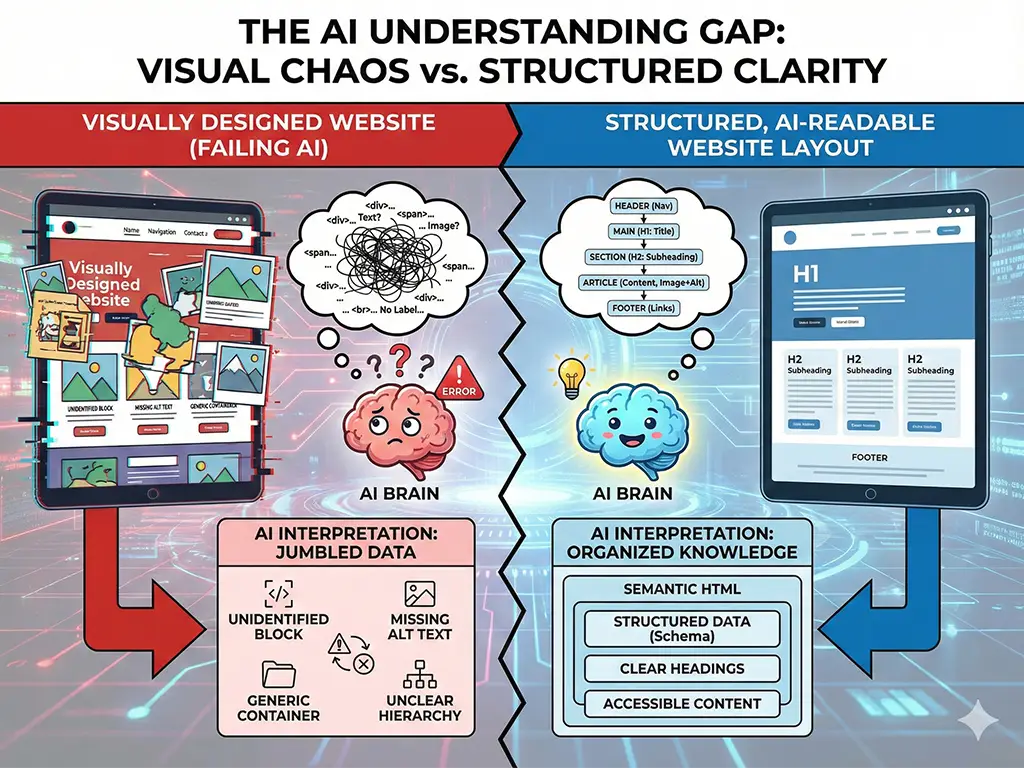
Traditional websites fail AI because they are designed for human eyes, not for machine understanding, relying on visual cues instead of clear structure.
Most business owners feel this pain even if they cannot name it. Their website looks modern, loads fast, and wins design awards, yet it underperforms in search, fails to appear in AI-generated answers, and delivers inconsistent leads. The issue is not the content quality or the colour palette. The issue is that AI cannot reliably read or interpret most websites built using traditional design-first thinking.
Why AI cannot read most traditional websites
AI systems struggle with most websites because visual design does not communicate meaning to machines.
Humans understand a website by scanning layout, typography, spacing, and visual hierarchy. We instinctively know what is important, what is secondary, and how information connects. AI systems do not see design the way people do. They rely on structure, semantics, and explicit signals embedded in the code and content.
When a website relies on layout tricks instead of structural clarity, AI encounters ambiguity. Headings may look prominent but lack proper hierarchy. Key information may be buried in sliders, tabs, or interactive elements that AI does not interpret consistently. Navigation labels may be clever but vague, offering no clear signal about the page purpose.
This creates a silent failure. The site functions for humans but becomes unreadable to search engines, voice assistants, and generative AI systems.
Design-first thinking creates invisible problems
Design-led websites often prioritise aesthetics at the expense of meaning.
Many modern sites are built with the goal of looking impressive rather than communicating clearly. Large hero sections, minimal text, abstract headlines, and animation-heavy layouts dominate. While these may appeal visually, they often remove the explicit context AI needs to understand what the business does, who it serves, and why it matters.
When a homepage headline says something like “Shaping the future together,” a human may scroll and infer meaning. An AI system cannot. Without clear definitions, supporting context, and structured relationships, the page becomes semantically empty.
This is why businesses experience declining organic visibility even after redesigns. The new site is prettier, but it explains less.
Structure beats design for AI understanding
AI understands websites through structure, not style.
Structure means using clear headings, logical content order, consistent terminology, and explicit relationships between ideas. It means each page answers a specific question, defines its topic early, and reinforces meaning throughout the content.
Proper structure allows AI to extract answers, summarise pages, and confidently reference your site. It also improves human comprehension, accessibility, and conversion clarity.
This does not mean design is unimportant. Design should support structure, not replace it. The most effective websites are visually appealing precisely because their structure is strong and intentional.
How to fix a website that fails AI
Fixing AI readability requires rethinking how your website communicates meaning.
Start by defining the purpose of every page in plain language. The first sentence should clearly state what the page is about. Avoid cleverness and prioritise clarity.
Use heading structures to map ideas logically. Each section should introduce one concept and expand on it without ambiguity. Avoid skipping heading levels or using headings purely for visual styling.
Explain key terms when they first appear and use consistent language throughout the site. AI systems depend on repetition and reinforcement to establish confidence.
Support structure with semantic markup where appropriate. This helps machines identify organisations, services, locations, and relationships without guessing.
Most importantly, design pages around questions users actually ask, not around visual layouts. When structure mirrors intent, AI can follow the logic.
Why AI-readiness is now a business requirement
AI-readiness is no longer optional because AI systems are becoming the primary interface between users and information.
Search engines increasingly surface answers instead of links. Voice assistants respond with single recommendations. Generative AI tools summarise and compare businesses without showing full pages. If your site cannot be parsed, interpreted, and trusted by AI, it effectively disappears from these experiences.
This shift affects visibility, credibility, and lead generation. Businesses that adapt early gain disproportionate exposure. Those that delay lose relevance without realising why.
Interon, a South African AI Readiness consultancy, helps organisations identify these hidden structural issues and rebuild their websites for both human and machine understanding.
Frequently Asked Questions
Why does my website rank worse after a redesign?
Many redesigns remove explanatory content and structural clarity in favour of visuals. This reduces the semantic signals AI and search engines rely on to understand relevance.
Can AI understand images and animations on websites?
AI can analyse images to a limited extent, but it still depends heavily on surrounding text, structure, and metadata to interpret meaning accurately.
Is AI-readiness the same as SEO?
AI-readiness builds on SEO but goes further. It focuses on helping AI systems extract, summarise, and trust information, not just rank pages.
Do I need to rebuild my entire website to be AI-ready?
Not always. Many issues can be fixed by improving structure, clarity, and content hierarchy without a full redesign.
Key Takeaways
- Most websites fail AI because they prioritise visual design over structural clarity.
- AI systems rely on headings, semantics, and explicit meaning, not layout or style.
- Design should support structure, not replace it.
- AI-readiness is now essential for visibility, credibility, and growth.
- Structural improvements often deliver results faster than visual redesigns.
If your website looks good but feels invisible, the problem is likely structural. Run an AI-readiness audit to uncover what AI systems cannot see and fix it before competitors do.
Run an AI-readiness audit at /audit/.