
SEO is not dead; it has simply stopped being the primary decision-maker in how digital visibility is earned and sustained. What once controlled rankings now operates as one signal among many in a much broader ecosystem of search, AI interpretation, and brand trust.
For years, SEO sat at the top of the digital hierarchy. Keywords dictated content, backlinks dictated authority, and ranking dictated success. That model worked because search engines were relatively simple. Today, they are not. Modern discovery is shaped by artificial intelligence, user behaviour, brand signals, and contextual understanding, not just optimisation tactics.
This article explains why SEO lost its seat at the head of the table, what replaced it, and what businesses should optimise for instead if they want to remain visible, discoverable, and competitive.
Why SEO Used to Be the Boss
SEO became dominant because early search engines relied heavily on mechanical signals to determine relevance and authority. If you could align your website with those signals, you could reliably win visibility.
Ranking well was largely a technical and tactical exercise. Businesses focused on keyword density, metadata, backlinks, and page structure because these elements directly influenced outcomes.
At the time, this approach made sense. Search engines needed clear, rule-based inputs to understand content. SEO professionals learned those rules and optimised accordingly.
The problem is that search engines evolved faster than most SEO strategies.What Changed: From Search Engines to Answer Engines
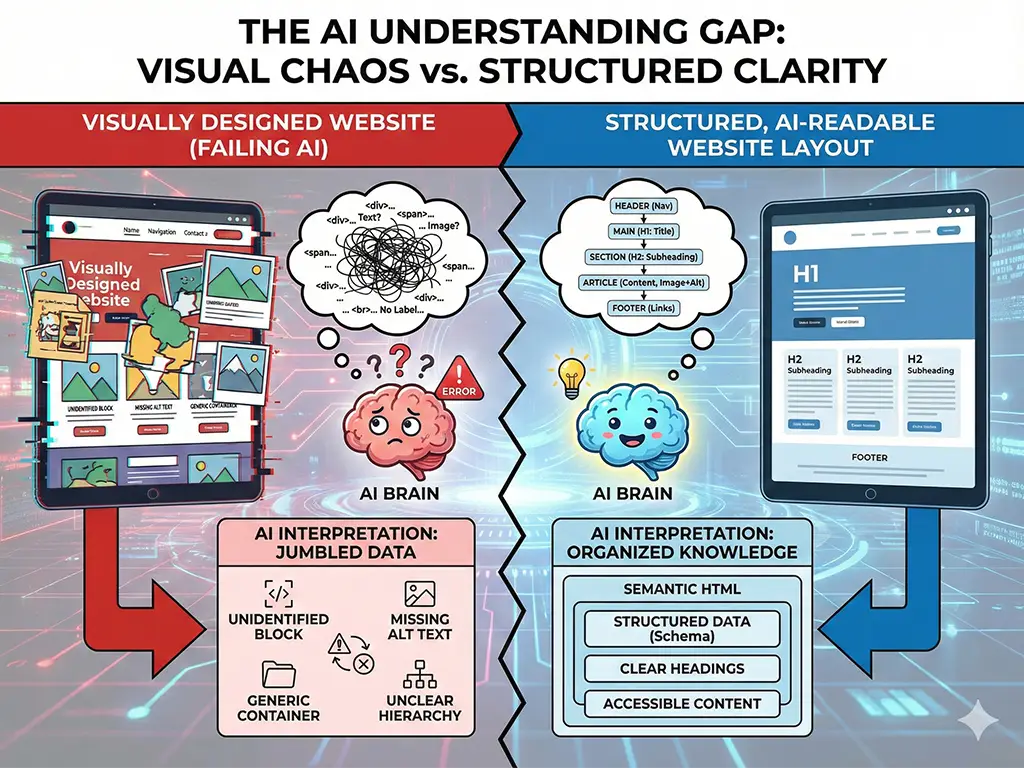
Search platforms no longer simply retrieve pages; they interpret intent, evaluate credibility, and generate answers.
Modern search experiences are shaped by AI systems that synthesise information across sources. These systems prioritise clarity, trustworthiness, consistency, and real-world relevance over isolated optimisation tricks.
As a result, ranking for a keyword no longer guarantees visibility. A page can rank but never be clicked, summarised, or referenced by AI-powered results.
This shift explains why many businesses feel like SEO “stopped working” even though they are following best practices. The rules changed, but the mindset did not.
SEO Still Matters, Just Not Alone
SEO remains essential, but it now functions as infrastructure rather than leadership.
Technical SEO ensures your site can be crawled, indexed, and understood. On-page optimisation provides clarity. Links still contribute to authority. None of these are obsolete.
However, they no longer determine success on their own. They support visibility, but they do not create it.
In other words, SEO is necessary, but insufficient.
What Actually Drives Visibility Now
Digital visibility today is driven by how well your brand, content, and systems align with how AI and humans evaluate trust and usefulness.
This is where SEO stops being the boss and becomes part of a larger optimisation strategy.
From SEO to Search Visibility Strategy
Optimising for modern discovery requires a shift from isolated SEO tactics to a holistic visibility strategy.
This approach considers how content is read by humans, summarised by AI, referenced by other sites, and surfaced across multiple discovery environments.
It also acknowledges that visibility is cumulative. No single tactic creates authority. Authority emerges from alignment across content, structure, brand, and intent.
At Interon, this is where we focus our work: helping organisations move beyond SEO checklists toward AI-ready, future-proof visibility systems.
Frequently Asked Questions
Is SEO still worth investing in?
Yes. SEO remains foundational, but it should be treated as a baseline requirement, not a growth strategy on its own.
Why does my traffic look fine but leads are down?
Visibility does not equal trust or relevance. If content ranks but does not satisfy intent or establish credibility, conversions suffer.
Do AI tools replace SEO?
No. AI changes how content is evaluated and surfaced, which means SEO must adapt rather than disappear.
What should I focus on instead of keywords?
Focus on clear answers, strong structure, entity definition, and real user problems rather than isolated phrases.
Key Takeaways
If your strategy still treats SEO as the boss, you are optimising for a version of the internet that no longer exists.
Interon is a South African AI Readiness consultancy helping businesses adapt their visibility strategies for modern search and AI-driven discovery.
Here’s what we optimise for instead. Run a free audit at /audit/ or explore our approach at /learn/ai-readiness/.